日本語のパーマカルチャーのサイト探しておられますか。
Nicco日本国際民間協力会
Permaculture Center Japan
Cecilia Macaulay
Monday, February 27, 2006


Sunday, February 19, 2006
Debunking Michael Crichton's State of Fear.
Reading about Bush's White House chat with Michael Crichton regarding his book State of Fear and having heard more and more from people about the book, I feel I must do something to address the errors and outright falsehoods in his book. With much help from Gavin Schmidt from RealClimate.org and others, let's look at the central claims of Crichton's work and see how it holds up to scrutiny.
One claim is that while carbon emissions were rising, temperatures from the 40s to the 70s were falling. This argument completely leaves out other climatic forcings. Those of you old enough (or well read enough) will know that in many industrialised the 1970 ushered in a new era of environmental regulation. Many countries saw the enacting of clean air laws which saw an immediate and significant drop in atmospheric aerosol levels. This is very significant because aerosols “dim” or cut down on solar radiation causing a cooling effect. And there are other forcings that need to be full considered before a definitive answer can be given. For example, changes in land usage, long-term oceanic cycles, changes in solar output, and volcanic aerosols could all have an effect. When we consider the current warming, however, no model has been able to explain it without including CO2, methane and other greenhouse gases.[1]
Next, Crichton makes much ado about his selective use of weather station data. Considering the long-term cooling trend at Punta Arenas in southern Chile, one of the heroes in Crichton’s book exclaims “There’s your global warming.” I honestly cannot understand how Michael Crichton, a well-educated man, can mistake one city for an entire globe. Cooling at Punta Arenas you say? Yes, ok. But warming at Harrow, Canada, warming at Mito, Japan, warming at Swindon England, etc. Global warming means an increase in the mean global temperature, not an increase in the mean temperature of Punta Arenas (or not) and Punta Arenas only. What he did was take (very) selective data that fit his hypothesis and ignored most of the planet to do so. Had Crichton looked at the airport in Santa Cruz, Chile, he would have found a long-term cooling effect. [2] But I should not be too harsh because his book is fiction pretending to be science, not science.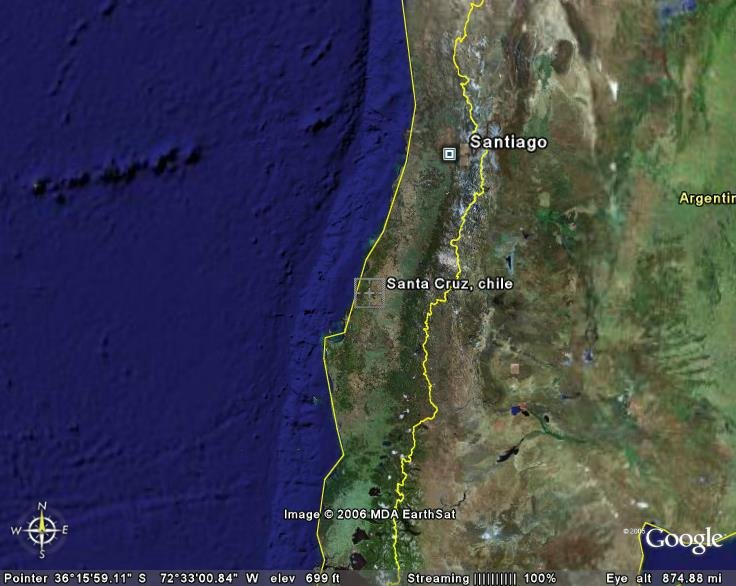
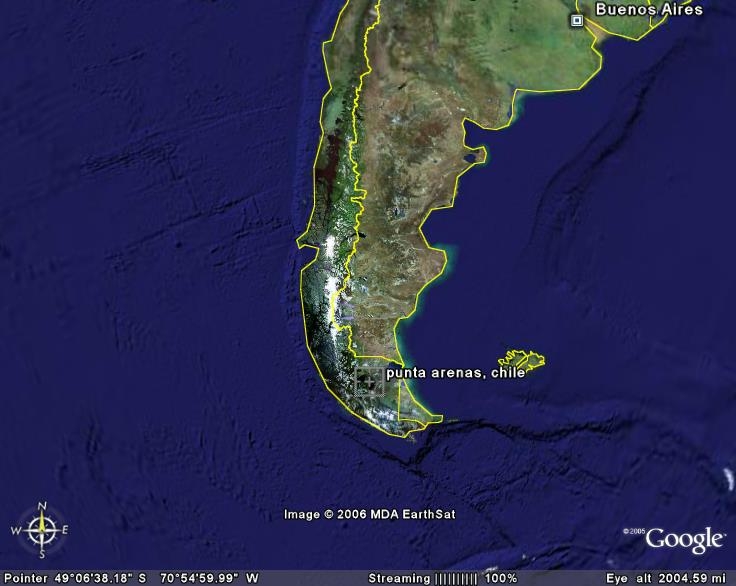
Another stop on Crichton’s local equals global tour is Antarctica. On problem with Antarctica is the lack of long-term data. The Larson-B ice shelf “has warmed substantially,” but data on the entire continent is scarce, so any long term claim is just guesswork.[3] Furthermore, Antarctica is, as many know, not the entire globe. It is one region. There is no way around it, mean global temperatures have risen.
Crichton, showing ignorance of the global warming debate, attacks Dr. James Hansen’s 1988 testimony to Congress saying that it was “overstated by 300 percent.” We can ask a simple question: Did Dr. Hansen do this? And we get a simple answer: No. What did Dr. Hansen do? After he testified, he and several colleagues published a paper that offered three scenarios. Scenario A has CO2 rising exponentially. Scenario B has an increase following historic trends with a large volcanic event occurring as well. And Scenario C arrests CO2 increases at the year 2000 with a large volcanic event occurring. Readers will recall the 1991 eruption of Mt. Pinatubo. In the end, Scenario B was the closest to the unfolding record. In other words, Dr. Hansen’s predictions were quite good and his testimony to Congress showed only the predictions in Scenario B. [4]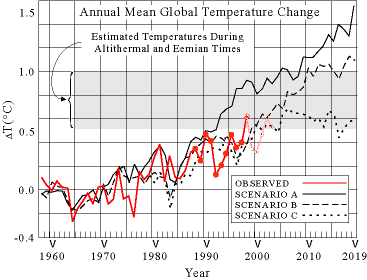
Where did Crichton go wrong? He relies on Patrick Michael’s 1998 testimony to Congress in which he conveniently deleted Scenarios B and C from Dr. Hansen’s work. In other words, willful deception on Michael's part. [5]
Crichton tries to make the claim that the perception of global warming is due to climatologists worldwide being to stupid to know about the thermal island effect of cities. No. Wrong. Climatologist David E. Parker published a piece in Nature in 2004 showing that this is not the case. [6] And perhaps the reader will have heard of a region called the Arctic which has no urban areas yet has undergone startling warming. [7]
Crichton raises the urban myth that "in the 1970's all the climate scientists believed an ice age was coming". Again, no. Wrong. If you have the inclination, you can read through the debunking of this claim by climate modeler William Connolley. [8]
Crichton pooh-poohs sea level rise in his book. That’s an odd thing to do with melting icecaps and glaciers. [9] No, sea level is increasing, though it is not perceived to be everywhere. Much of the northern hemisphere is still literally rebounding from the last ice age. Some other areas are subject to tectonic forces that cause the land to rise. Interestingly, the data Crichton offers in his footnotes is evidence of a rise in sea level. [10]
In yet another case, Crichton cites a paper saying that it claims Kilimanjaro is melting because of deforestation, not global warming. The problem is that his source does not say this at all. [11] Douglas Hardy, who Crichton cites says Crichton “the denialists always to do” which is to take things out of context, or take elements of reality and twist them a little bit, or combine them with other elements of reality to support their desired outcome.'' [12]
In a sane world, Crichton's work would be seem for what it is: a work of fiction and nothing more. Unfortunately, however, we live in a world where false ideas are not only influencing the media, but also Congress and the White House as well. If there is any solace, it is that the deniers must turn to a work of fiction to try to support their claims. Unfortunately, important ears are listening to those claims.
1. http://www.realclimate.org/index.php?p=74
2. http://www.realclimate.org/index.php?p=74
3. http://www.realclimate.org/index.php?p=18
4. http://www.realclimate.org/index.php?p=74
http://www.grist.org/advice/books/2005/02/01/schmidt-fear/index.html
5. http://www.realclimate.org/index.php?p=74
http://www.grist.org/advice/books/2005/02/01/schmidt-fear/index.html
6. http://www.realclimate.org/index.php?p=74
http://www.nature.com/nature/journal/v432/n7015/abs/432290a.html
7. http://www.pewclimate.org/state_of_fear.cfm
8. http://www.wmconnolley.org.uk/sci/iceage/ http://www.realclimate.org/index.php?p=74
9. http://www.monbiot.com/archives/2005/05/10/junk-science/
10. http://www.pewclimate.org/state_of_fear.cfm http://www.realclimate.org/index.php?p=74
11. http://www.realclimate.org/index.php?p=129
http://www.boston.com/news/globe/ideas/articles/2005/02/06/checking_crichtons_footnotes/
http://www.boston.com/news/globe/ideas/articles/2005/02/06/checking_crichtons_footnotes?pg=2
12. http://www.boston.com/news/globe/ideas/articles/2005/02/06/checking_crichtons_footnotes?pg=2
Saturday, April 02, 2005
Allium Sativum
 Allium sativum (garlic)
Repels: Japanese beetle, aphids, fungus, root maggots, snails, carrot root fly, red spider mites
Guild: Roses, raspberries, tomatoes, peach
Dislike peas.
Propagation: cloves planted in 3~5cm deep soil. Chill cloves in fridge for several weeks before planting. Bend flower and foliage to the ground or cut them off to cause plant to focus energy on the bulbs.
5 months to maturity. Harvest when leaves dry.
Accumulates sulfur
Grows best in pH 6.0 to 7.0. Needs irrigation in summer when bulbs are forming.
Garlic is prone to onion maggots. Sprinkling a fair amount of cayenne pepper, ginger, dill or chili powder on the ground around the plant is reported to be effective against these pests.
Garlic juice can be used against some plant pests and diseases. Some recommend mixing it with mineral oil and pure soap as an insecticide. It’s effective against aphids, cabbageworms, leafhoppers, mosquito larvae, squash bugs and whiteflies. It works on some fungi and some problem nematodes. To prepare the solution, set 1/3 cup of minced garlic in 2 teaspoons of mineral oil for 24 hours. Add 500ml of water and about 5-6ml of liquid dish soap. Mix the solution and strain it. Add one or two tablespoons of this solution to 500ml of water to make an insecticidal spray.
Thursday, February 03, 2005
Some Thoughts on Edge
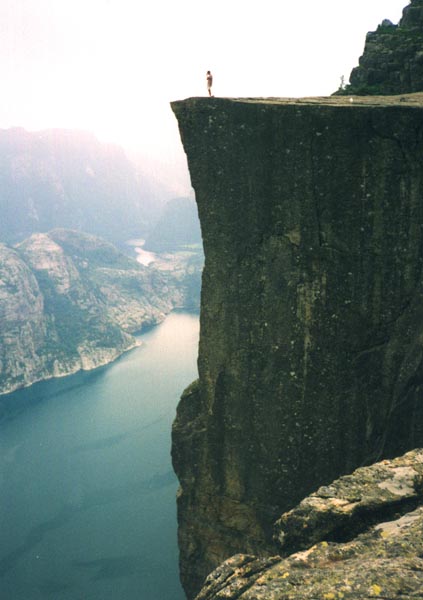 For those not familiar with permaculture, edge is the boundary between two elements. Examples of edge include the boundary between land and sky, water and sky, or water and land.
Edge is where all the action takes place. Fish congregate around structures in a lake and not at some neutral middle point in a lake (if they do, it is always around a temperature boundary). Deciduous trees generally lose their leaves from the outside edges first where the wind gets at them and knocks them loose. The nutrients from your food are absorbed into your body via the stomach wall and intestinal walls – ie. an edge. Gas exchange in hemoglobin occurs via the cell wall.
However, the importance of edge is not limited to the biological world. If one looks, the same patterns are found in the social world, for better or for worse. Health insurance did not arrive in Germany in1883 via a sudden kind-hearted decision of policy-makers. It came from a movement that started as a fringe and came to define the course of that nation’s history. Similarly, when universal suffrage was guaranteed in the United States in 1965 (ie. guaranteeing voting rights for Black voters), it again was not the result of the kind acts of powerful elites. It was the result of a “fringe” that spread its ideas; and those ideas came to define the society as a whole. (The same can also be said of regressive elements in society – eg. fascism.)
With this in mind, the permaculture “fringe” can understand its role in its attempt to change the structure of our societies. This “fringe” has reached its its tipping point in Australia and is now mainstream. In the world of international development aid, permaculture (or permaculture systems operating under a different name) are now recognised as the only design systems that can yield a truly sustainable result, and, as such, are right on a tipping point in that sphere.
Tuesday, January 25, 2005
Getting started...

This blog will be an organic outpouring of ideas, observations and plans relating to permaculture. The problem with such an endeavor is not finding material. Rather it is where to begin with a field as vast as permaculture.
As such, chaos is inevitable. Not everything can be placed into neat little categories. However, I shall do what I can to maintain some semblance of order for the readers (assuming there are any).
With that said, let’s get this ball rolling…
Subscribe to:
Posts (Atom)